 On eBay Now...
Ancient Roman Egyptian Bronze Isis Hathor Goddess Pendant 40mm Loop c. 100 BC For Sale
When you click on links to various merchants on this site and make a purchase, this can result in this site earning a commission. Affiliate programs and affiliations include, but are not limited to, the eBay Partner Network.

Ancient Roman Egyptian Bronze Isis Hathor Goddess Pendant 40mm Loop c. 100 BC:
$365.15
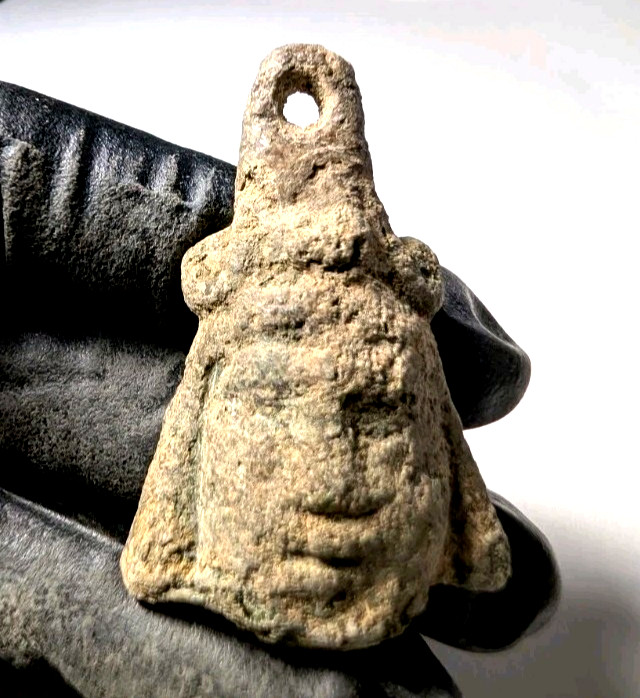
Graeco-Roman / Levantine Bronze Crowned Goddess Head Amulet Pendant (Approx. 40mm — c. 2nd Century BC – 2nd Century AD)
Authenticity & Guarantee
Certification: Certified Authentic — includes signed Certificate of Authenticity (COA) with full provenance documentation.
Provenance: Ex-private European collection, legally acquired from international sales; Graeco-Roman / Levantine-Egyptian Sphere.
Item Specifications & Estimated Dimensions
Object: Cast Bronze Divine Goddess Head Amulet / Bust Pendant (Isis / Hathor / Astarte)
Culture / Period: Graeco-Roman to Levantine-Egyptian Era (Hellenistic to Roman Imperial Period)
Date Range: Circa 2nd Century BC – 2nd Century AD (c. 200 BC – 200 AD)
Estimated Dimensions: Approx. 4.0 cm height (40 mm) × 2.2 cm width (Extrapolated from hand scale)
Material: Cast Bronze (Copper Alloy)
Form & Architecture: Cast bronze relief pendant depicting a divine female head / bust; rendered with almond-shaped eyes, defined nose, and broad lips, framed by structured shoulder-length wig locks / hair flaps; surmounted by a raised crown / modius headdress terminating in a complete, integrated suspension loop; flat/solid reverse matrix
Condition: Exceptional, 100% complete ancient condition. Complete intact suspension loop, crisp facial modeling, preserved under an authentic pale sandy-tan earthen burial encrustation over a solid dark charcoal-olive bronze core with light malachite highlights. Free of modern restoration or tooling.
Syncretic Goddess Cults in the Hellenistic & Roman Levant
During the Hellenistic and Roman Imperial periods, syncretic worship of mother goddesses—combining Egyptian Isis/Hathor with Levantine Astarte/Atargatis—spread rapidly across the Eastern Mediterranean and Levant. Bronze pendants depicting the crowned bust of the goddess were worn as personal talismans to invoke maternal protection, divine favor, fertility, and safe passage along trade routes.
Iconography & Integrated Suspension Architecture
The prominent tapering headdress (modius / stephane) combined with framing side locks draws on royal and divine iconography. Ancient metalsmiths engineered the suspension loop directly into the crown at the top of the casting, allowing the amulet to hang level when worn on a leather thong or beaded necklace.
Typological Analysis & Exact Classification
Primary Class: Ancient Religious Jewelry / Bronze Divine Amulet Pendant
Sub-Class: Crowned Goddess Head / Bust Pendant with Suspension Loop Class
Manufacturing Technique: Lost-wax cast copper alloy with an integrated top suspension loop.
Comparable Archaeological Examples & Museum Accession Numbers
British Museum (Accession No. 1888,0601.24): Graeco-Roman bronze bust pendant of Isis-Hathor with suspension loop.
Metropolitan Museum of Art (Accession No. 26.7.1420): Roman provincial bronze head amulet depicting a crowned goddess.
Israel Museum, Jerusalem: Roman period Levantine bronze female deity pendants recovered from Holy Land contexts.